Why Innovation Depends on Building Structure and Taking It Apart
Useful knowledge can also hold us to familiar answers. Research on fixation and creativity complicates a layered account of innovation and suggests questions to test in AI skill transfer.
Part 4 of 4 in the series “The Background Work of Innovation.”
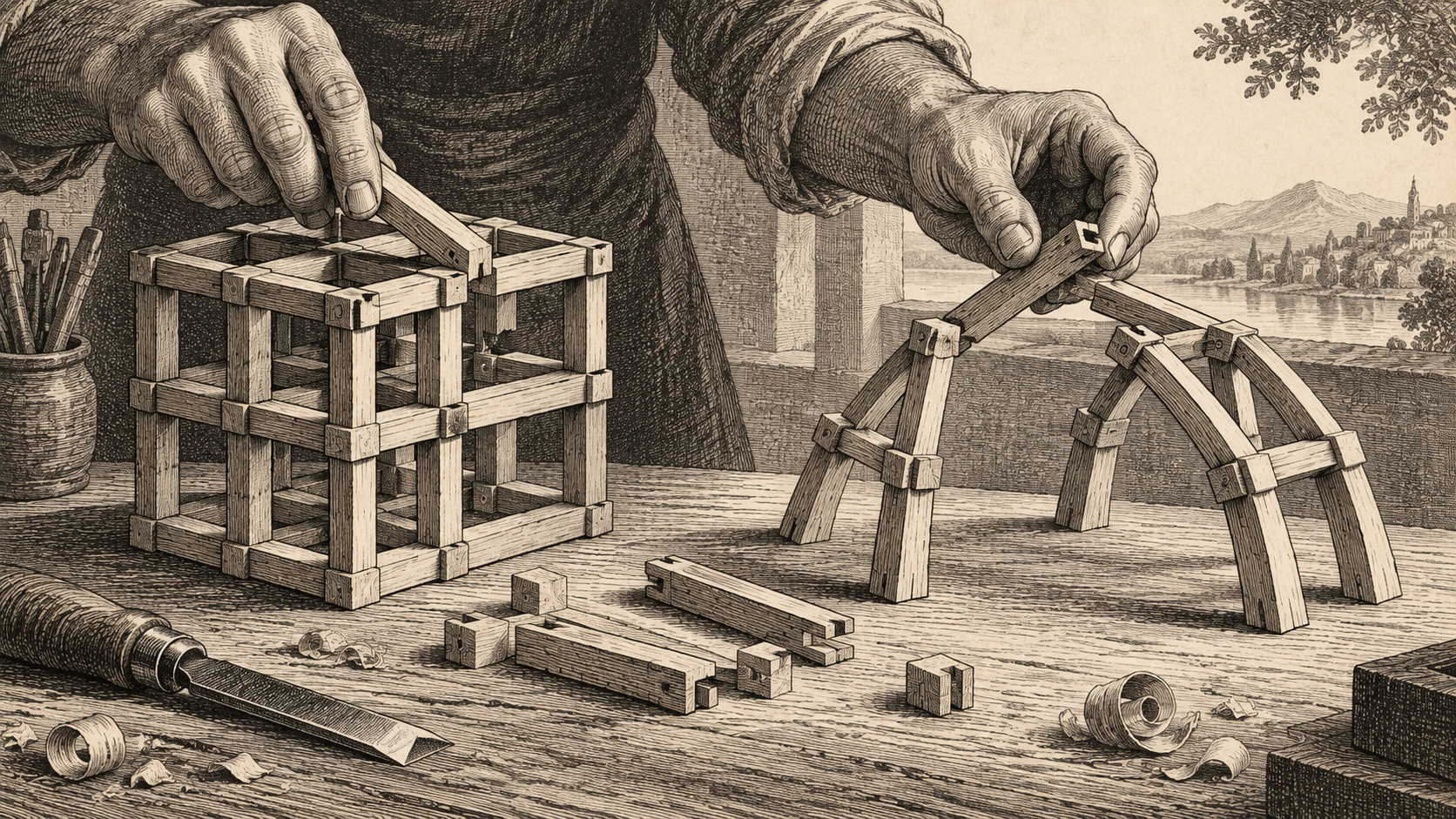
In the first three articles in this series, I built the case for a hypothesis about innovation: the brain keeps working on a problem even when we are not deliberately thinking about it, starting from concepts we already know, expanding them into layers of structure, and using those layers to reason about something new.
The evidence supports several components, with different levels of confidence. Breaks and sleep sometimes improve later performance. Prior knowledge shapes imagination and learning. And relationships among learned items can support new inferences. The studies do not establish the entire sequence as one mechanism.
But a hypothesis deserves its strongest challenge, not just its best evidence. The research contains one: the same structures that make reasoning possible can also stop us from finding a better answer.
Studies of expert chess players show that a familiar solution can hold attention even while players report searching for alternatives.[1] Matchstick experiments support roles for relaxing constraints and breaking apart perceptual chunks.[2] A theoretical sleep model proposes complementary forms of reorganization,[3] while neuroimaging links creative task performance to patterns of network connectivity.[4] These are distinct contributions to the argument.
The complication is that knowledge can guide a useful search and also constrain it. I therefore want to keep the original hypothesis while asking when the structures it describes help, when they mislead, and what allows people to revise them.
Good thoughts can block better ones #
Psychologists call it the Einstellung effect: the first idea that comes to mind, triggered by familiar features of a problem, prevents a better solution from being found. It affects both people facing new problems and experts working within their own field.[1]
In a 2008 study in Cognition, Merim Bilalić, Peter McLeod, and Fernand Gobet examined how it works in expert chess players. The players were shown positions in which a familiar checkmating pattern was available, but a shorter solution also existed.[1]
Having found the familiar solution, the players reported that they were looking for a better one. Their eye movements told a different story. They kept looking at the squares and pieces related to the solution they had already found.[1]
The authors interpreted the gaze pattern as evidence that an activated schema could guide subsequent attention. They also suggested possible connections to broader biases. Those broader applications were interpretations, not additional phenomena tested by the chess experiment.[1]
This matters for my hypothesis because the players' knowledge is what let them find the familiar solution so quickly. The structure that made the first answer easy made the better answer hard to see.
Some insights require taking structure apart #
Insight research offers a related finding. In a 1999 study, Günther Knoblich, Stellan Ohlsson, Hilde Haider, and Detlef Rhenius proposed that people reach an impasse on insight problems because of how they represent them, and that they break the impasse by changing the representation.[2]
They described two ways this can happen. One is relaxing an assumption about what counts as a valid solution. The other is decomposing a perceptual chunk: a group of elements that people normally see as a single unit. They tested their predictions in four experiments using matchstick arithmetic, in which a false equation written in Roman numerals must be made true by moving a single stick. The results were consistent with their predictions about which problems would be harder and how solving one kind of problem would transfer to another.[2]
The authors described overcoming an impasse as a special case of a general need to:
“override the imperatives of past experience in the face of novel conditions.” [2]
This is an important qualification for my hypothesis. Familiar chunks can make some arrangements hard to reconsider. But decomposing a Roman-numeral chunk is not necessarily the same process as revising an abstract principle, and neither experiment establishes that the change occurred offline.
Building and restructuring may alternate #
If structure both enables and blocks new ideas, how might the brain manage both? One proposal comes from a 2018 paper in Trends in Cognitive Sciences by Penelope Lewis, Günther Knoblich, and Gina Poe. Knoblich is also one of the authors of the matchstick research above.[3]
Their starting point is that creative thought depends on reorganizing existing knowledge. They propose that different stages of sleep contribute in different ways. Memory replay during non-REM sleep may abstract rules from a body of learned information. Replay during REM sleep may promote novel associations. They suggest that alternating between the two across a night helps build complex knowledge frameworks and also allows those frameworks to be restructured.[3]
This is a theoretical proposal, not an experimental result. The authors outline a computational model intended to make it testable. I include it because it is the closest published proposal I have found to my own hypothesis, and because it builds in the refinement this article is about: structure is built and then revised, not built once.
Spontaneous and deliberate thinking work together #
The original hypothesis leaves open how background processing interacts with active reasoning. A related question is whether processes associated with spontaneous and controlled thought can cooperate during a task.
In a 2018 study in PNAS, Roger Beaty and colleagues used functional MRI to scan 163 participants during a classic divergent thinking task, in which people generate creative uses for everyday objects. They identified a pattern of brain connectivity associated with higher-quality ideas, with hubs in the default, salience, and executive networks.[4]
The connectivity pattern predicted creative task scores in participants held out from training and in three external datasets. The external correlations for the high-creativity network were 0.35, 0.28, and 0.13, so the predictions were informative but limited.[4]
The default network is often associated with internally directed thought, and executive networks with control. Those broad associations are not direct readings of a participant's mental process. This study was correlational: it did not show that increasing network cooperation causes creativity, or determine the order in which ideas were generated and evaluated. It does help distinguish activity during a creative task from offline processing between attempts.[4]
A working model of the hypothesis #
The papers support parts of the hypothesis, but they study different tasks, timescales, and kinds of representation. I can connect them into a working account only if I keep those differences visible.
Preparation supplies relevant material. Initial learning mattered in several experiments. The sleep-stage results varied across tasks, and the evidence does not establish one best offline state for innovation. (Part 1)
Known concepts can shape what comes next. Familiar categories influence imagined examples, and organized prior learning can help assimilate compatible information. Citation evidence offers a separate association between conventional backgrounds, unusual combinations, and scientific impact. (Part 2)
Relationships can be abstracted from cases. Comparison can help people identify a shared schema. Resting replay can express previously learned structure, which is a different finding from showing that rest creates a new abstraction. (Part 3)
Structure can support new inferences. Learning relationships can support answers that were never directly taught. A useful representation is not sufficient by itself: people must retrieve it, recognize its relevance, and apply it appropriately. (Part 3)
Structure sometimes needs revision. Familiar solutions and perceptual chunks can constrain a search. The chess and matchstick results support that risk. Alternating sleep processes are a proposed explanation, and connectivity during creative tasks provides correlational evidence about a different level of organization.[1][2][3][4]
The hypothesis remains:
When we innovate, the brain works in the background. It starts from concepts we already know, expands them into layers of structure, and those layers are what eventually allow us to reason about something new.
The qualification belongs around the hypothesis: the background contribution is conditional, “layers” is a model of useful organization, and those structures may need revision. The full causal chain remains to be tested. Treating it as a hypothesis lets it guide research without presenting the proposed mechanism as settled.
What this means for AI skill transfer #
This series began with the brain. It also suggests an approach worth testing in the work I described in Why We Keep Humans at the Center of AI Skill Transfer. This is an engineering extrapolation from human research, not evidence that an AI system learns or reasons through the same mechanism.
An AI Agent Skill containing only cases might omit useful principles and boundaries. It does not follow that it must behave like a human novice: a model may already possess relevant abstractions, and examples can sometimes convey a rule. My proposal is to compare case-only skills with skills that also state relationships, decision criteria, and exceptions.
Comparison is one practical tool. Instead of asking the SME to explain a single decision, the AI Skill Designer can ask:
“Show me two cases you handled the same way. What do they have in common?”
And then:
“Now show me a case that looked similar but that you handled differently.”
These prompts are inspired by the analogy research. They could help an AI Skill Designer and observing agents draft explicit decision rules. Those rules still need to be checked against decisions and held-out cases: a plausible explanation from an SME is not automatically a complete account of how the SME actually decides.
Spacing is another tool, although I hold it more loosely. If sleep and rest reorganize what people have engaged with, an SME who returns to a problem after a break or a night's sleep may articulate structure that was not available in the first session. That is a hypothesis worth testing, not an established finding.
Finally, the Einstellung research suggests a useful evaluation question: does the skill select a familiar answer when the evidence calls for another one? Similar-looking cases with different correct actions would test that risk more directly than another successful replay of a training example.
The real test happens on the next problem #
A hypothesis this broad cannot be proven by any single study, and the research I have reviewed does not test it as a whole. Most of it comes from laboratory tasks: puzzles, number sequences, invented creatures, abstract patterns, and chess positions.
For people, I would randomly vary comparison practice and opportunities to step away, measure prior knowledge, and score both ordinary solutions and cases designed to trigger fixation. Independent measures of the proposed representations would help test whether structural change explains any improvement. Separating these components matters: a benefit from a bundled intervention would not reveal which part produced it.
For AI skill transfer, I would compare the same model and tools using cases alone, cases plus principles, and cases plus principles and boundary conditions. Each condition should have the same information budget, with repeated examples or neutral detail used to control for length. Evaluation would use previously unseen cases, misleading lookalikes, exceptions, and cases where the right action is to seek more information.
I would measure decision accuracy, inappropriate rule application, confidence calibration, and justified escalation. Human reviewers should assess outcomes without knowing which skill version produced them. If principles and boundary conditions improve performance at a matched budget, that would support the engineering approach. It would not prove that AI systems reproduce the brain mechanism proposed here.
The human hypothesis and the engineering proposal can succeed or fail independently. Better performance after a break would not prove that new layers formed. Better AI performance with explicit principles would not validate an account of sleep. Each connection needs evidence appropriate to its claim.
The goal is structure that can be revised #
I began this series with a familiar experience: the idea that seems to arrive on its own. The research gives us reasons to investigate preparation, background processing, organized knowledge, and flexible use of that knowledge. It supports components of the hypothesis while leaving the links between them open.
The final piece matters as much as the others. A useful representation can guide us toward a solution, but it can also keep a familiar answer in view. My working proposal is to build representations that can be examined, tested on unfamiliar cases, and revised when they fail.
The most important question is not “Where did the idea come from?” It is “What structure made it possible, and when does that structure need to change?”
Previous in this series: Part 3: How Known Concepts Become Layers of Structure
References #
-
Bilalić, M., McLeod, P., & Gobet, F. (2008). Why good thoughts block better ones: The mechanism of the pernicious Einstellung (set) effect. Cognition, 108(3), 652–661.
-
Knoblich, G., Ohlsson, S., Haider, H., & Rhenius, D. (1999). Constraint relaxation and chunk decomposition in insight problem solving. Journal of Experimental Psychology: Learning, Memory, and Cognition, 25(6), 1534–1555.
-
Lewis, P. A., Knoblich, G., & Poe, G. (2018). How memory replay in sleep boosts creative problem-solving. Trends in Cognitive Sciences, 22(6), 491–503.
-
Beaty, R. E., Kenett, Y. N., Christensen, A. P., Rosenberg, M. D., Benedek, M., Chen, Q., Fink, A., Qiu, J., Kwapil, T. R., Kane, M. J., & Silvia, P. J. (2018). Robust prediction of individual creative ability from brain functional connectivity. Proceedings of the National Academy of Sciences, 115(5), 1087–1092.
Cite this article #
When quoting or referencing this article, credit Paul Greenberg and RapidKT and link to the article. Include the section title when directing readers to a particular passage.
Suggested citation
Greenberg, P. (2026, October 2). Why Innovation Depends on Building Structure and Taking It Apart. RapidKT. https://rapidkt.com/pages/blog/why_innovation_depends_on_building_structure_and_taking_it_apart
In-text reference: (Greenberg, 2026).