What Remains After an Immersive Learning Experience
How Project Eden could measure lasting knowledge, independent reasoning, and transfer through delayed tests and controlled comparisons.
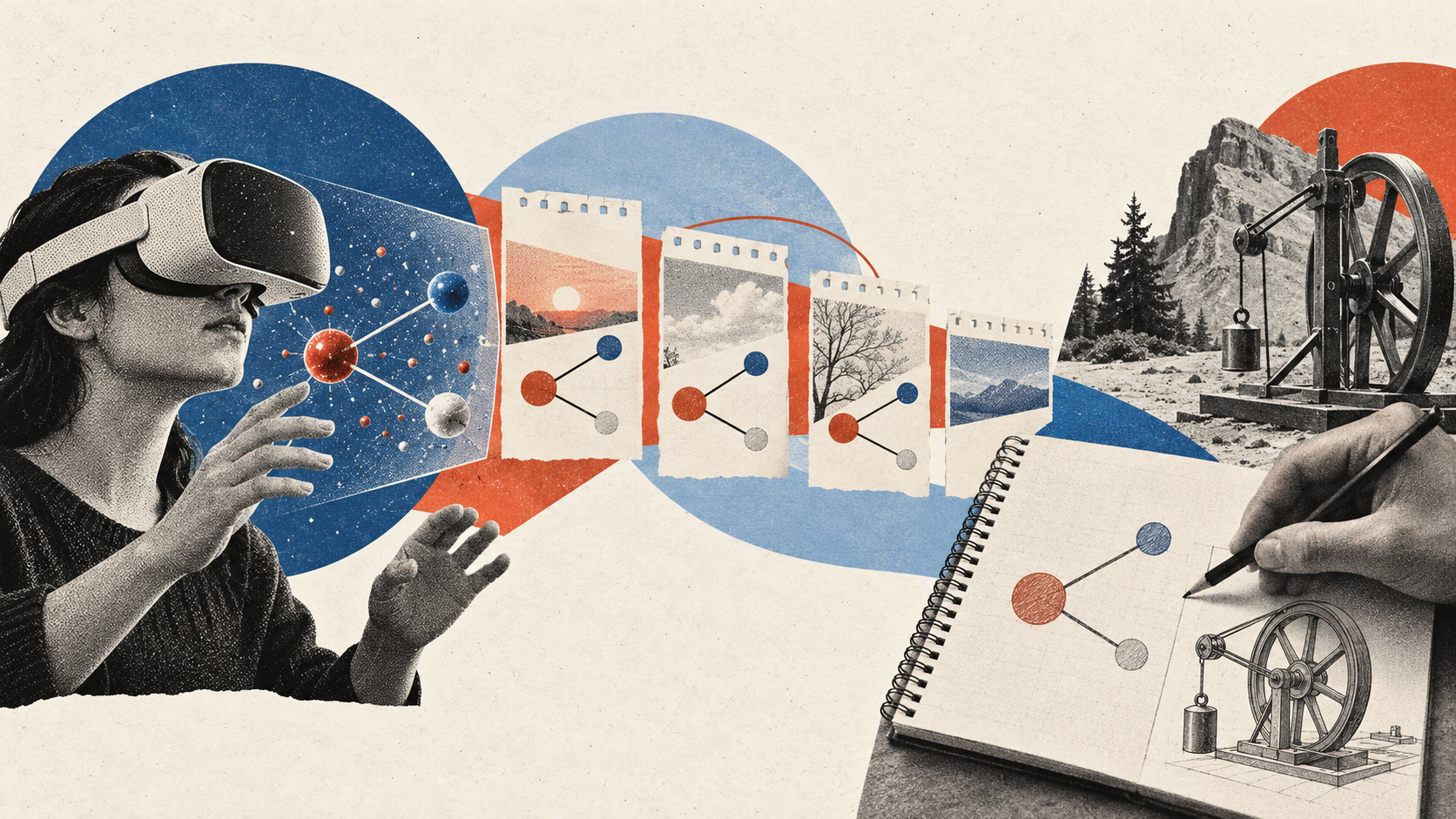
A person takes off a VR headset after successfully completing a difficult experiment. They can manipulate the controls, recover from mistakes, and reach the objective. A month later, the controls are gone. So are the prompts, the familiar scene, and the immediate feedback. What can that person still explain or do?
That is the outcome I want to investigate through Project Eden, a research and development initiative in Cognitive Engineering and Applied Neuroplasticity. Our work began with transferring human expertise to AI agents. Eden explores how expertise, immersive experiences, interactive hardware, and deliberate practice might help people develop capabilities they can use independently.
The practical questions are specific: which knowledge should persist, for which learners, for how long, and in what unfamiliar situations should it become useful? Asking whether an experience helps retention requires both an explanation of why it might work and a method for finding out whether it does.
This article proposes an evaluation framework. It does not report results from an Eden trial. Our publicly available VR prototype, Fusion Reactor, provides a starting point. The comparisons, research instrumentation, and assessment tasks below describe work to develop and validate. Numerical examples are hypothetical.
Separate performance, retention, and transfer #
Performance is what a learner does under the conditions of a particular test. During training, it can depend on visible instructions, recent repetition, controller familiarity, and help from another person or an AI agent. Learning is inferred from changes that remain useful over time or across situations. Soderstrom and Bjork reviewed why improvements during practice can be a misleading guide to durable learning. [1]
For Eden, I would measure factual recall, conceptual explanation, and task execution separately. Knowing a definition, explaining why a result occurred, and choosing a useful experiment are related accomplishments. Combining them into one game score would hide which capability changed.
Retention concerns persistence across time. Transfer concerns usefulness across tasks or contexts. They form two dimensions of an evaluation.
| Assessment | Familiar knowledge or task | Unfamiliar task or setting |
|---|---|---|
| Immediately after learning | What was acquired under the present conditions? | Can the learner apply it to a new case now? |
| After a meaningful delay | What remains accessible without renewed instruction? | Can the learner still recognize and use it somewhere new? |
A learner could remember fusion terminology and fail to design a useful experiment. Another could forget some terminology while retaining a productive way to test competing explanations. Both patterns would matter. Neither should disappear into a single claim that the experience “worked.”
Here, retention means retention of knowledge or skill. Returning to the app is a separate engagement measure. A return visit may create another learning opportunity, but it does not establish what the person remembers.
Choose a learning domain and a learner #
The first study should begin with a bounded question about introductory physical science. Fusion Reactor lets people manipulate a simplified particle simulation and explore the effects of heat and pressure. A useful initial target is understanding relationships between inputs and outcomes, together with reasoning about how to investigate those relationships.
Before recruiting participants, a physicist and a learning researcher should audit the experience. Which claims are physically accurate? Which are instructional simplifications? Which rules exist only to make the game playable? Assessment should distinguish understanding the simulation from understanding the physical phenomenon it represents. Mastering the controls cannot certify expertise in nuclear fusion.
I would begin with adults who have little prior knowledge of the target concepts. Baseline screening should establish that starting point. Being new to fusion is different from being new to VR, mathematics, or experimental reasoning. Record those differences and provide the same device familiarization before the learning comparison.
Experts would require a different study. Their useful outcomes might include diagnosing unusual cases, identifying model limitations, or recognizing when a familiar procedure fails. Basic tutorial questions would risk a ceiling effect. Research on the expertise reversal effect shows that instructional support useful to inexperienced learners can become redundant or counterproductive as knowledge grows. [2]
An experience intended for ages 13 and above does not define a scientifically coherent sample. Adolescent learners would belong in a separately designed study with appropriate assent, guardian permission, and research oversight. Results from adult novices should stay attached to that population.
The broader ambition can span domains. Each extension still needs its own account of what should transfer. Faster development makes it easier to construct alternative experiments. It does not make the resulting learning effects domain independent.
Why an immersive experience might improve retention #
My working hypothesis is that an experience can organize useful learning activities: retrieving an idea, predicting an outcome, testing that prediction, receiving informative feedback, and explaining what changed. VR may make some relationships easier to inspect or manipulate. The contribution of each activity needs evidence.
The following findings motivate design choices. They are evidence from other tasks and populations, not measurements of Eden.
Retrieve an idea before revealing the answer #
In experiments with prose passages, Roediger and Karpicke found that repeated study could produce better recall after five minutes, while prior retrieval produced better retention after longer delays. The short-term impression of success and the later learning outcome pointed in different directions. [3]
For an Eden research build, a learner could predict the result of a proposed change before the simulation runs. A later trial could ask them to reconstruct the explanation without a visible reminder. Whether that activity improves later understanding would be tested against a version with otherwise comparable content and timing.
Karpicke and Blunt also reported benefits of a retrieval-based study procedure on one-week tests of the studied science texts, including questions requiring inference. A later preregistered experiment by Mayrhofer and colleagues found no statistically significant retrieval advantage on verbatim questions after one week when concept mapping also included a dedicated memorization phase and instructions to include as much information as possible. This was not an equivalence test. Its inference results followed a different pattern, and the authors cautioned that only two inference questions were used. These findings support testing well-specified learning procedures, rather than declaring one activity universally superior. [4] [5]
A controller movement counts as retrieval practice only if it requires recalling relevant knowledge. Repeating an action because a glowing target indicates the next step may exercise a different capability.
Revisit ideas across time #
Cepeda and colleagues studied fact learning across substantial intervals and found that the spacing associated with the best later retention depended on how far away the final test was. The result supports planning review around a retention horizon, rather than assuming that one interval is always optimal. It does not establish an optimal schedule for a VR reasoning task. [6]
A later Eden experiment could compare a single concentrated session with several shorter sessions containing the same total planned practice. Report both time since the first session and time since the last session. If everyone takes the final test on the same calendar day, the distributed group may have practiced more recently. That schedule can still be useful, but the interpretation must include recency.
The first retention study should keep review exposure the same across groups. A second study could deliberately vary review. Otherwise, a benefit from extra sessions might be attributed to the original gameplay.
Compare cases and explain the relationship #
A promising design asks learners to compare cases that look different but share a relevant relationship. Gick and Holyoak found that comparing two analogous source problems could support abstraction and later analogical problem solving under their experimental conditions. This offers a reason to test comparison activities, while leaving open whether learners will recognize the relationship without a prompt. [7]
In a research scenario, one trial might succeed and another fail. The learner would explain which difference matters, propose a discriminating experiment, and state what observation would change their mind. The assessment would later remove the original visual cues.
This is also where feedback needs care. “Try again” conveys little about the learner’s explanation. A useful research variant would connect the observed result to the prediction and invite a revision. A mechanism study could randomize that feedback feature while holding the surrounding experience constant.
Test the value of immersion itself #
Immersion can attract attention without improving the target learning. In a study of 52 university students, Makransky, Terkildsen, and Mayer found greater reported presence but smaller knowledge-test gains with a head-mounted science simulation than with its desktop presentation. The difference in transfer-test gains was not statistically significant. That finding concerns a particular design, not every use of VR. [8]
There is also positive evidence. Makransky and Mayer studied 102 school students taking a virtual field trip within a six-lesson climate-change intervention. The headset group scored higher on immediate and delayed knowledge tests than students who watched the same field-trip content as a projected 2D video. The delayed assessment occurred about three weeks after the field trip, following further lessons, so it measures an instructional sequence rather than isolated retention after one exposure. [9]
Together, these studies make instructional design and the comparison condition central. For Eden, the proposed benefit is that spatial interaction could help learners inspect meaningful relationships and run useful experiments. Visual spectacle, navigation demands, or discomfort could also consume attention. Presence, enjoyment, workload, and discomfort should therefore be measured alongside independent learning outcomes.
A compelling experience gives us an opportunity to teach. The later test determines what that opportunity produced.
Design a comparison that answers a clear question #
A tutorial-only group and a tutorial-plus-gameplay group provide a reasonable early comparison of two packages. If the second group receives more relevant practice, feedback, or instructional time, however, a difference cannot identify what gameplay itself contributed.
For a first controlled study, I would randomly assign eligible learners to two credible ways of using the same learning period. Both would receive the same introductory material, target concepts, total scheduled time, assessment schedule, and facilitator attention.
| Condition | Learning activities | What is held comparable |
|---|---|---|
| A: guided study and practice | Tutorial followed by worked cases, prediction questions, explanations, and feedback using the same headset environment. | Target content, planned duration, device exposure, breaks, and opportunities to encounter the core ideas. |
| B: interactive experimentation | The same tutorial followed by learner-controlled experiments, prediction questions, explanations, and feedback in a research version of the game. | The same target content and planned duration, with learner control of experiments as the intended difference. |
The comparison would estimate the value of the interactive learning package relative to a strong alternative. It would not isolate every ingredient. If feedback, task sequence, and learner choice all differ, the conclusion must name that package. A narrower experiment could use matched replay cases or randomize a single feature.
Specify the actual schedule after piloting tolerable session lengths. For example, a 60-minute appointment could include device orientation, common instruction, the assigned practice, breaks, and assessment. It should not silently become 60 uninterrupted minutes inside a headset. Record completed learning time as well as scheduled time.
To ask whether the headset adds value, run a separate comparison between the same interactive task in VR and on a desktop. A larger study could cross medium with learning activity in a two-by-two design. That requires enough participants to estimate the interaction. Merely giving one group a video and the other a rich interactive environment confounds medium with instruction.
Participants will know which experience they receive. Present both as credible learning methods, use consistent instructions, measure expectations, and keep outcome scorers unaware of assignment. Randomization addresses baseline differences. It does not automatically remove every difference in delivery.
Measure learning on a defined schedule #
A test an hour later can reveal early retention. It cannot establish durability over weeks. I would choose the primary delay before examining results, based on when the knowledge is supposed to be useful. Thirty days is a defensible initial research target, not a biological threshold.
| Time | Purpose | Example measurement |
|---|---|---|
| Before instruction | Characterize prior knowledge and stratify random assignment. | Brief conceptual baseline, relevant background, and separate device familiarization. |
| Immediately after instruction | Estimate initial acquisition. | Unassisted explanation and prediction on equivalent items outside the training interface. |
| Day 7 | Examine early persistence, if repeated testing is part of the design. | An alternate form, with feedback withheld until designated assessments are complete. |
| Day 30 | Measure the primary delayed outcome. | An independently scored conceptual-understanding test, followed by a separately scored transfer task. |
| After the main endpoints | Test relearning or preparation for future learning. | A standardized new lesson and subsequent independent problems. |
There is an important complication: tests are learning events. The retrieval-practice evidence means that an immediate test and a day-seven test can influence day-thirty performance. Changing the wording of the questions reduces answer memorization but does not remove retrieval of the underlying concepts. [3]
A practical pilot can assess everyone on the same schedule, provided the conclusion describes learning followed by that assessment schedule. For a stronger test of persistence without interim retrieval, randomize assessment schedules within each learning condition. One cohort could receive immediate and day-seven assessments, while another receives only the day-thirty outcome after the common baseline.
The latter cohort estimates delayed outcomes without those interim tests. It cannot provide an individual immediate-to-delayed decline. The repeatedly tested cohort provides a trajectory under repeated assessment. These answer different questions and should be reported separately. The additional assignment also needs to be reflected in sample-size planning.
Baseline questions can likewise prime attention to what matters. Keep the baseline identical across arms and avoid revealing the held-out transfer principle. If baseline sensitization is a central concern, a later study can randomize baseline testing too.
Track outside study, repeat app use, interval length, and major interruptions. Use neutral follow-up reminders. An observational association between sleep and later performance would remain an association. Testing a sleep mechanism would require a dedicated design, as discussed in What the Brain Does After We Stop Working on a Problem.
Calculate retention without hiding initial learning #
I would make the primary outcome a day-thirty score on a validated, unassisted conceptual-understanding assessment. One candidate instrument is ten short scenarios, each scored from zero to two using explicit criteria, then rescaled to 0–100. Its suitability would need piloting. The intended construct is retained understanding of the taught relationships, with factual recall and transfer scored separately.
To see why a single retention percentage is insufficient, consider the following invented group means. Assume that the assessment forms have been shown to measure the same construct on a comparable scale, and that both groups followed the same repeated-testing schedule.
| Assessment | A: guided practice | B: interactive experimentation |
|---|---|---|
| Baseline | 40 | 40 |
| Immediate | 70 | 80 |
| Day 7 | 55 | 68 |
| Day 30 | 46 | 60 |
Delayed performance: B scores 60 and A scores 46 at day thirty, a raw difference of 14 points on the 0–100 scale. This answers the practical question of which group can demonstrate more knowledge at the chosen delay. It does not, by itself, isolate a slower forgetting process.
Initial gain: immediate score minus baseline is 40 points for B and 30 for A. Retained gain: day-thirty score minus baseline is 20 points for B and 6 for A. Observed loss: immediate score minus day-thirty score is 20 points for B and 24 for A.
An optional descriptive calculation is retained gain fraction = (delayed score − baseline score) / (immediate score − baseline score). Applied to these group means, it gives 50% for B and 20% for A. This is the fraction of the observed initial gain still present on this assessment scale. It is not the percentage of a person’s memory that survived.
The fraction is unstable when initial gain is small, undefined when it is zero, and difficult to interpret when it is negative. It can exceed 100% if delayed scores improve. Baseline error enters both numerator and denominator. A ratio of group means also differs from the average of individual ratios. I would report the scores and uncertainty first, and keep this fraction descriptive.
A simple second example exposes the distinction between more learning and slower loss. If one group goes from 80 immediately to 65 later, and another goes from 70 to 55, the first group still has a ten-point delayed advantage. Both lost fifteen points. The observed advantage does not demonstrate a slower decline.
Estimate the delayed advantage and the change over time #
For the primary randomized comparison, a prespecified baseline-adjusted model could estimate the day-thirty group difference: delayed score = intercept + treatment effect × group + baseline effect × baseline score + prespecified terms + error. The group coefficient estimates the difference in score points after the stated adjustment. Vickers and Altman explain the rationale for baseline adjustment in controlled trials with follow-up measurements. [10]
Report the adjusted group difference and its confidence interval alongside raw distributions, the instrument’s scale, and the number assessed. Check whether the score distribution supports the planned model. Strong floor or ceiling effects may call for an item-level or other bounded-outcome model specified before the confirmatory analysis.
The primary model should not automatically adjust for immediate post-training performance. That score is already affected by the intervention. Conditioning on it changes the question and can introduce bias. For a secondary trajectory analysis, repeated-measures models can estimate group-by-time differences while accounting for measurements from the same learner.
To study forgetting after similar initial mastery, design a separate experiment in which participants train to a prespecified common criterion and then begin the retention interval. Report everyone assigned, including those who do not reach the criterion and the time required. Selecting only successful learners afterward would produce a different, selected sample.
These measures let us distinguish a larger initial gain, a smaller later loss, and faster reacquisition. Each could be valuable. They require different evidence.
Turn “two levels removed” into a testable transfer claim #
The intuition behind a derivative skill several steps away from the original topic is valuable: learning should become useful beyond the original scene. But “two levels removed” has no standard measurement scale. It could mean a different vocabulary, a new interface, a different domain, or a genuinely new reasoning demand.
Barnett and Ceci proposed describing transfer across multiple dimensions, including knowledge domain, physical setting, time, function, social context, and modality. Their framework helps specify what changed between learning and assessment. It does not turn those changes into a universal distance score. [11]
For an Eden study, I would preregister a transfer map around one candidate skill: designing an intervention that distinguishes competing causal explanations. This is an objective for a research version to teach and assess. It should not be assumed to follow automatically from the current game.
| Task | What changes | What success would show |
|---|---|---|
| A new case within the fusion simulation | Starting conditions and the correct solution, while the interface remains familiar. | Generalization beyond the practiced configuration. |
| A fusion problem presented through diagrams and a data table | The interface, representation, and available actions. | Use of the taught relationships without the original spatial and controller cues. |
| A plant-growth experiment with competing explanations | The subject matter and surface details, while an informative comparison can distinguish causes. | Transfer of experimental reasoning to a different domain, given the necessary domain facts. |
| An unfamiliar device with interacting inputs | The domain, response format, and causal structure. A single-factor explanation is insufficient. | Adaptation of the strategy to new evidence, including recognition of its limits. |
For example, a learner sees two explanations for why a plant failed to grow: insufficient light or insufficient nutrients. A good response proposes a comparison that can distinguish the explanations, predicts the results under each, and explains how the observation would update the conclusion. The task would supply the necessary biological background so that unfamiliar vocabulary does not dominate the score.
The unfamiliar-device task should also include cases where two inputs interact. Changing one variable at a time is useful in some investigations, but it is not a universal solution. A learner who repeats that slogan regardless of the evidence has acquired a rule without its boundary conditions.
Include superficially similar cases where the trained strategy is inappropriate, and different-looking cases where it is useful. Score both correct application and inappropriate application. Otherwise, indiscriminate use of a newly taught rule can masquerade as flexible reasoning.
The primary transfer task should arrive without a suggestion to use what happened in the reactor. A later standardized hint can measure prompted transfer. Keep those scores separate. A prompt changes the recognition demand, which is part of the capability under investigation.
Also separate direct transfer from a taught chain. If participants practice the plant task before attempting the device task, success on the device may reflect the intervening practice. To claim direct transfer from the initial experience, hold out the target tasks or assign separate target-task cohorts. To study a chain deliberately, randomize the intermediate lesson and describe the chain explicitly.
A positive result on one carefully selected analogy would justify that specific transfer claim. Broader claims need multiple held-out task families, varied representations, and replication. Changing the scenery while preserving every response cue is a weaker test than requiring a learner to recognize the relationship for themselves.
Ask whether the learner can acquire the next skill faster #
Some benefits may become visible only when a person encounters new instruction. A learner might not solve an unfamiliar problem unaided, yet understand its explanation more quickly because earlier experience prepared the relevant distinctions.
Schwartz and Martin investigated this idea in ninth-grade statistics instruction. Their embedded assessment experiment included transfer tests with and without a worked-example learning resource. An invention-based condition showed an advantage over tell-and-practice when the resource was available. Without it, the observed transfer scores were similar, which does not establish equivalence. This is evidence for preparation for future learning in that setting. It is not evidence that any exploratory activity produces general learning ability. [12]
An Eden extension could assess an unfamiliar task once without assistance, give both groups the same short lesson, and then present new problems. Compare final independent accuracy, trials needed to reach a defined criterion, and use of the new explanation. Measure initial target-task performance so that an existing head start is visible.
For a stronger causal test, independently randomize the new learning resource within each original training group. Ask whether prior training changes the benefit of receiving that resource. The resulting interaction distinguishes preparation for new instruction from simply arriving with a higher score. It requires a larger study than giving every participant a lesson.
Schedule this extension after the primary retention and transfer outcomes, or in a separate cohort, because the new lesson changes subsequent learning. Learners who never reach the criterion must remain visible in the analysis. Comparing completion time only among those who succeed can reward a condition that leaves more people behind.
This gives the derivative-skill idea a concrete outcome: whether a specified earlier experience helps someone learn a specified later skill under equal instructional opportunity.
Use interaction data to investigate the reasoning process #
Outcome tests establish what changed. Interaction records can help explain how the change developed. For a private research build, I would log the task state, available evidence, prediction, chosen action, observed result, feedback, help request, and next attempt. Each event should carry a timestamp and the content, software, and guidance versions that produced it.
The useful unit is often a decision sequence. Suppose a learner predicts an outcome, sees contradictory evidence, and then runs a comparison that separates two explanations. That sequence is more informative about experimental reasoning than the number of retries alone. To interpret it, the log must preserve what alternatives were available at the time.
Candidate process measures include the proportion of decisions preceded by a prediction, the quality of the chosen comparisons, changes after disconfirming feedback, and performance when prompts fade. Brief explanations at selected points can help distinguish deliberate testing from accidental success. Asking for an explanation also changes the activity, so apply those prompts consistently or randomize them as an intervention.
Each behavioral proxy has alternatives. Long response time could indicate reflection, confusion, motor difficulty, or distraction. Fewer help requests could indicate independence or avoidance. Repeated success could reflect conceptual learning or exploitation of a game rule. Validate a sample of inferred strategies against human-coded records and independent assessments.
A process measure that predicts later performance is not automatically a causal mechanism. Learners with stronger prior knowledge may both choose better experiments and score higher later. Randomizing a design feature gives stronger evidence about its contribution. Mediation claims require additional assumptions about the relationship between the proposed mediator and the outcome.
When building predictive models from these records, separate learners across training and evaluation data. Randomly splitting events from the same person can leak individual patterns into both sets. Evaluate on held-out people, tasks, and eventually sites. Thousands of interactions from twenty people still provide twenty independently assigned participants, not thousands.
Measure what remains when AI assistance is withdrawn #
If expertise from AI agents is meant to become a human capability, independent assessment is essential. A high score obtained while an agent supplies the next move measures the performance of the assisted system. The learner’s later performance without that assistance answers a different question.
Bastani and colleagues demonstrated the importance of this distinction in a field experiment involving nearly a thousand high-school mathematics students at one school in Turkey. Their basic GPT-4 interface, called GPT Base, improved assisted practice performance but produced worse performance on the unassisted exam within the same session than the control condition. A tutor designed with learning safeguards largely mitigated that harm, without establishing a positive unassisted exam effect in the main comparison. This was mathematics instruction, and the exam result does not establish retention over weeks. It makes assistance design a concrete research question. [13]
For Eden, a later study could compare a standardized hint policy with adaptive guidance that asks for a prediction, supplies a limited cue, and fades support as performance develops. Keep training tasks and time comparable, then test both groups with the agent absent. These are proposed variants, not a claim that the public Fusion Reactor release already contains such a tutor.
Measure independent accuracy, explanation quality, and the ability to reject an unsuitable suggestion. A separate assisted assessment can remain useful for studying collaboration. Counterbalance equivalent test forms if assistance conditions are compared within a person, because seeing the assisted solution first can teach the unaided answer.
Freeze or fully record the model version, instructions, retrieval sources, and assistance policy during a trial. Expert-review the domain content. If the tutor changes midway through data collection, participants may no longer have received the same intervention.
The benefit I would seek is increasing human independence at a useful level of performance. Immediate speed with help is another outcome, but it cannot substitute for that one.
Make the assessments worthy of the claim #
An assessment can be precise about the wrong thing. A quiz built from the game’s labels may measure familiarity with those labels. A controller-based test may favor experienced gamers. A long written explanation may disadvantage a learner who understands the relationship but has difficulty expressing it in the test language.
Build the assessment from a learning-objective blueprint before examining outcomes. Have independent subject experts review its accuracy and coverage. Pilot the instructions and alternate forms with people resembling the target population. Check for floor effects, ceiling effects, ambiguous questions, and differences in reading or device demands.
For the transfer task, one proposed rubric has four dimensions, each scored zero, one, or two: identifying the relevant relationship, selecting a discriminating action, justifying the predicted evidence, and revising or limiting the explanation appropriately. Zero means absent or incorrect, one means partially correct, and two means correct with the evidence required by the task-specific scoring guide. The eight-point total is a candidate instrument, not a validated scale.
Use several scenarios and publish example responses at each scoring level. Have two blinded raters independently score a prespecified subset, report agreement before resolving disagreements, and adjudicate using the written rubric. An AI scorer would need validation against that process and checks for systematic differences across response styles. It should not be the sole judge of benefits attributed to AI-guided learning.
Record confidence before revealing feedback. Then examine whether confidence tracks correctness, including confident errors. A learner who becomes more certain without becoming more accurate has not necessarily improved their judgment.
Keep target assessments separate from instructional authoring. Review whether generated lessons or tutor responses expose the held-out problems, their wording, or their solution patterns. Equivalent forms need evidence of comparability, not merely different nouns.
Correctness, explanation quality, and time should remain interpretable on their own. A combined efficiency score can conceal a speed–accuracy tradeoff. If the intended benefit is equal learning in less time, define an acceptable learning difference in advance and design an equivalence or noninferiority comparison. A nonsignificant difference on a small study does not establish equality.
Decide what would count as evidence before collecting it #
The first confirmatory claim should be narrow: for the defined novice population, does the interactive condition improve the prespecified day-thirty conceptual-understanding score relative to the active comparison? Choose the assessment schedule that claim refers to. Treat transfer, calibration, process measures, and future learning as explicitly ranked secondary or exploratory outcomes.
Preregister the assignment procedure, primary contrast, scoring, exclusion rules, missing-data approach, stopping rule, and handling of multiple outcomes. If both retention and transfer are confirmatory claims, plan the testing hierarchy or multiplicity adjustment and sample size accordingly. Finding one favorable result among many outcomes is a different evidential situation from confirming a designated primary outcome.
Choose a smallest effect worth detecting based on the educational use case and the instrument. Lakens describes why sample-size justification should connect the planned data to the intended inference, including effect sizes of interest and desired precision. A small feasibility study can establish whether the procedures and assessments function. It usually cannot settle a broad efficacy claim. [14]
For scale, consider a hypothetical two-group design with independent participants, equal allocation, a two-sided 5% significance level, 80% power, and a standardized difference of 0.4 selected as the planning target. A simple normal approximation gives about 98 completed participants per group. Allowing 20% loss gives about 123 recruited per group. These are illustrative inputs, not an estimated Eden effect or a final recruitment recommendation.
The actual calculation should use the final outcome model and account for assessment-schedule groups, unreliable measurements, clustered recruitment, and any interaction that matters. Effects from a small promising pilot are an uncertain basis for planning. Precision under several plausible assumptions is more useful than one optimistic estimate.
Analyze participants according to random assignment for the primary treatment-policy question, including people who struggled or stopped early. Report completion and dropout by condition. Missing follow-up scores still require assumptions: prespecified imputation or model-based approaches should be accompanied by sensitivity analyses for plausible worse outcomes among people who did not return.
Do not silently discard learners who became uncomfortable or failed the tutorial. Those experiences affect the practical value of the intervention. If classmates influence each other or assignment occurs by class, account for that clustering. If task items are sampled to support broader generalization, account for variation across items as well as learners.
Report effect sizes, uncertainty, and distributions. A confidence interval spanning both negligible and useful benefits indicates unresolved uncertainty. A sufficiently precise interval excluding the prespecified worthwhile benefit is more informative evidence against that benefit. Neither conclusion should be reduced to whether a single p-value crosses a threshold.
Keep the research instrument distinct from the public experience #
The public version of Fusion Reactor does not collect the interaction and performance data proposed for this research. A private research instance is planned to support that work. The instrument should capture the minimum data required to answer the registered questions and link sessions through pseudonymous participant identifiers.
Before collection, the research team would establish informed consent, access controls, storage and deletion arrangements, withdrawal procedures, and the appropriate institutional review. Voice, gaze, body movement, and other detailed streams should be added only when a specific question justifies them. More data does not automatically produce a more valid explanation.
Provide clear pause and stop procedures, record discomfort consistently, and design accessible alternatives where possible. Recruitment and completion reports should describe who the setup could accommodate. These details help determine to whom the result applies.
What a claim about neuroplasticity would require #
Eden’s interest in Applied Neuroplasticity gives the research a direction. Behavioral improvements alone cannot identify a neural pathway that was created or strengthened. Better delayed reasoning would be meaningful evidence about learning even if the biological mechanism remained unresolved.
Draganski and colleagues reported training-associated changes in regional gray-matter estimates from MRI in volunteers who learned to juggle. MRI detected a macroscopic change without identifying its cellular mechanism. That study does not establish the neural effects of Fusion Reactor, and an imaging change by itself is not a measure of broader intelligence. [15]
Likewise, a successful transfer task would not establish a general increase in intelligence. Sala and Gobet’s meta-analysis of working-memory training in typically developing children found that benefits did not extend reliably to far-transfer outcomes in studies with active control groups. That is a different intervention and population. Its relevance is the evidential burden on broad cognitive-enhancement claims. [16]
If a later Eden study asks a neural question, it should specify the hypothesized process, a suitable neural measure, an active comparison, and a predicted relationship to independent behavioral outcomes. EEG, imaging, pupil measures, and interaction logs measure different things. None should be treated as a universal meter of cognitive growth.
The first obligation is to establish what people can retain, explain, and use. A mechanistic program can then investigate which changes account for those capabilities.
Let different results lead to different conclusions #
A research program becomes more useful when the possible findings have consequences for the next design. The following outcomes would lead to different decisions.
| Observed pattern | Interpretation to investigate | Next decision |
|---|---|---|
| Better gameplay, no clear independent benefit | The advantage may depend on interface cues or support. A wide interval may also mean the study is inconclusive. | Examine assessment sensitivity and dependence on prompts before expanding the claim. |
| Better delayed domain knowledge, no transfer advantage | Evidence of retention within the assessed material, without demonstrated generalization to the target tasks. | Improve comparison and abstraction activities, then test transfer again. |
| Better transfer only after a hint | Learners can use the relationship when prompted but may not recognize its relevance independently. | Investigate recognition cues and separate prompted from spontaneous application. |
| Better learning from the next lesson | Possible preparation for future learning under the tested instructional sequence. | Replicate with held-out lessons and examine the resource-by-training interaction. |
| Benefits in both independent retention and held-out transfer | Support for a bounded claim about durable and usable learning. | Replicate across participants, task families, settings, and longer delays. |
| More enjoyment, similar learning, greater time or discomfort | An engagement benefit with a practical tradeoff. | Evaluate access, learner preference, and costs against the intended use. |
The possible benefits are concrete: more knowledge available when needed, less time spent relearning, better experiments in a new setting, or less dependence on guidance. Each should be tied to its own measure. Motivation may also matter if it causes people to pursue further learning, which would need a separate longer-term assessment.
An effective package can still be impractical. Record setup time, hardware requirements, facilitator effort, completion, and follow-up burden. If a less expensive format achieves comparable outcomes within prespecified bounds, that is useful evidence for selecting the delivery method.
The development sequence I would follow is an expert content audit and assessment pilot, a randomized active-control study, a focused test of the most plausible mechanism, and replication with held-out tasks and another population. Each stage should earn the scope of the next claim.
The capability that remains after the experience ends #
My answer to the retention question begins with a specific population and a bounded learning objective. For the first Eden study, I would start with novice adults learning selected physical-science concepts and experimental reasoning. I would test whether interactive practice improves independent understanding after a delay, then separately examine whether that reasoning becomes useful in unfamiliar problems.
The explanation to investigate is that prediction, retrieval, informative feedback, comparison, and well-timed review can help learners build knowledge they can access later. Immersion and AI guidance are design variables within that account. Their value depends on what they enable people to learn.
The resulting evidence would include a delayed group difference with uncertainty, a transparent record of what was taught and tested, and a transfer map showing exactly where the capability did or did not travel. It would also show who benefited, who struggled, and what happened when help was removed.
The most interesting moment may come well after the headset is put away: a person encounters a new problem, notices a useful relationship, and chooses a better next step. Project Eden should be designed so that we can find out whether that change occurred, how long it lasted, and what helped produce it.
References #
The references include controlled experiments, reviews, a transfer framework, and methodological guidance. Their roles and limits are described where they are cited. None reports an evaluation of Project Eden.
-
Soderstrom, N. C., and Bjork, R. A. (2015). Learning versus performance: An integrative review.
Perspectives on Psychological Science, 10(2), 176–199.
Read paper
Review of learning and performance.
-
Kalyuga, S., Ayres, P., Chandler, P., and Sweller, J. (2003). The expertise reversal effect.
Educational Psychologist, 38(1), 23–31.
Read paper
Review of instructional support and expertise.
-
Roediger, H. L., III, and Karpicke, J. D. (2006). Test-enhanced learning: Taking memory tests improves long-term
retention. Psychological Science, 17(3), 249–255.
Read paper
Experiments on retrieval and delayed recall.
-
Karpicke, J. D., and Blunt, J. R. (2011). Retrieval practice produces more learning than elaborative studying with
concept mapping. Science, 331(6018), 772–775.
Read paper
Experiments on science-text learning.
-
Mayrhofer, R., Kuhbandner, C., and Frischholz, K. (2023). Re-examining the testing effect as a learning strategy: the
advantage of retrieval practice over concept mapping as a methodological artifact. Frontiers in Psychology, 14,
1258359.
Read paper
Preregistered study of the comparison procedure.
-
Cepeda, N. J., Vul, E., Rohrer, D., Wixted, J. T., and Pashler, H. (2008). Spacing effects in learning: A temporal
ridgeline of optimal retention. Psychological Science, 19(11), 1095–1102.
Read paper
Experiment on spacing and retention intervals.
-
Gick, M. L., and Holyoak, K. J. (1983). Schema induction and analogical transfer. Cognitive Psychology, 15(1),
1–38.
Read paper
Experiments on analogy and abstraction.
-
Makransky, G., Terkildsen, T. S., and Mayer, R. E. (2019). Adding immersive virtual reality to a science lab simulation
causes more presence but less learning. Learning and Instruction, 60, 225–236.
Read paper
Science-simulation media comparison.
-
Makransky, G., and Mayer, R. E. (2022). Benefits of taking a virtual field trip in immersive virtual reality: Evidence
for the immersion principle in multimedia learning. Educational Psychology Review, 34, 1771–1798.
Read paper
Field-trip study within a longer instructional sequence.
-
Vickers, A. J., and Altman, D. G. (2001). Analysing controlled trials with baseline and follow up measurements.
BMJ, 323, 1123–1124.
Read paper
Statistical methods note.
-
Barnett, S. M., and Ceci, S. J. (2002). When and where do we apply what we learn? A taxonomy for far transfer.
Psychological Bulletin, 128(4), 612–637.
Read paper
Framework for specifying transfer claims.
-
Schwartz, D. L., and Martin, T. (2004). Inventing to prepare for future learning: The hidden efficiency of encouraging
original student production in statistics instruction. Cognition and Instruction, 22(2), 129–184.
Read paper
Studies of preparation for future learning.
-
Bastani, H., Bastani, O., Sungu, A., Ge, H., Kabakcı, Ö., and Mariman, R. (2025). Generative AI without guardrails can
harm learning: Evidence from high school mathematics. Proceedings of the National Academy of Sciences, 122(26),
e2422633122.
Read paper
Field experiment on assisted and independent performance.
-
Lakens, D. (2022). Sample size justification. Collabra: Psychology, 8(1), 33267.
Read paper
Methodological guidance on sample-size planning.
-
Draganski, B., Gaser, C., Busch, V., Schuierer, G., Bogdahn, U., and May, A. (2004). Changes in grey matter induced by
training. Nature, 427, 311–312.
Read paper
Brain-imaging study of juggling training.
-
Sala, G., and Gobet, F. (2020). Working memory training in typically developing children: A multilevel meta-analysis.
Psychonomic Bulletin & Review, 27, 423–434.
Read paper
Meta-analysis of a different cognitive-training intervention.
Cite this article #
When referencing this article, credit Paul Greenberg and RapidKT and link to the article. Include the section title when directing readers to a particular passage.
Greenberg, P. (2026, October 29). What Remains After an Immersive Learning Experience. RapidKT. https://rapidkt.com/pages/blog/what_remains_after_an_immersive_learning_experience