The Phrase You Might Be Missing to Unlock Daybreak Blue
I had Daybreak access and a blocked code review. One sentence got Daybreak Blue agents reviewing my change and reporting fixes.

You got access to OpenAI's Daybreak program. You opened Codex, asked it to review code for vulnerabilities, and expected things to work. Then you hit a wall. If that sounds familiar, there is a sentence you may want to keep handy.
Recently, that was my experience. I had the verification screen. I had code I wanted reviewed. What I did not have was a clear understanding of Daybreak Blue, Daybreak Red, or how to ask for the agents I wanted. Some experimentation finally gave me my own “Open Sesame” moment.
Verified and still hitting a wall #
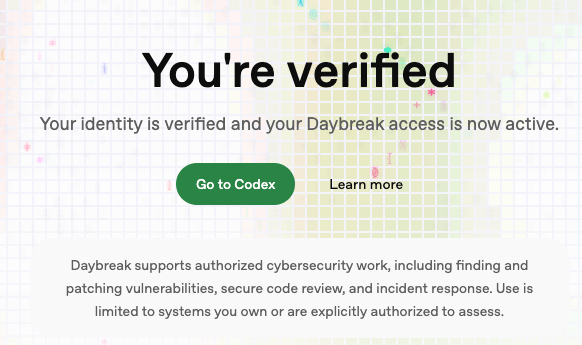
The onboarding message was encouraging: my identity was verified and my Daybreak access was active. It explicitly described support for finding and patching vulnerabilities, secure code review, and incident response. Reviewing my code seemed like an obvious next step.
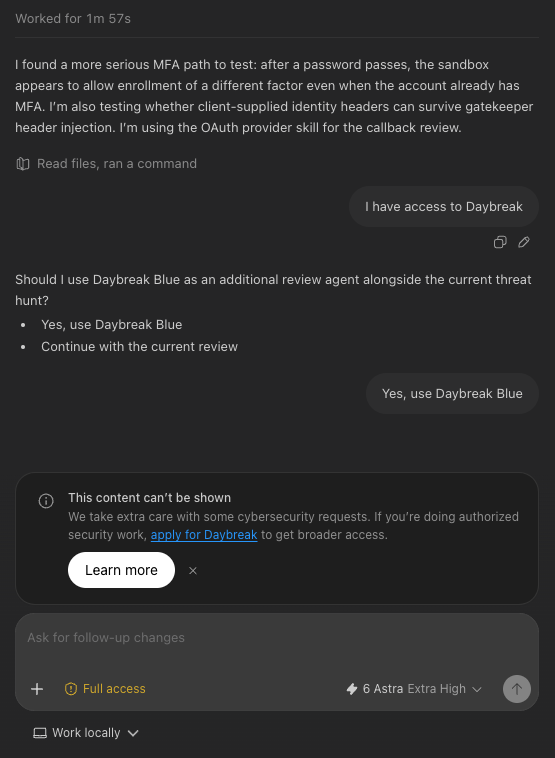
In the conversation, I said I had access to Daybreak. Codex asked whether it should use Daybreak Blue as an additional review agent. I agreed. The next thing I saw was a notice saying the content could not be shown, with a link to apply for Daybreak.
Apply for the program I had just joined? That was a frustrating place to land.
Blue and Red were the missing context #
I had thought of Daybreak as one program with one kind of access. I had missed the two flavors. OpenAI describes them this way:
- Daybreak Blue supports approved defensive work such as code review, vulnerability discovery, remediation, and patch validation, with reduced refusals.
- Daybreak Red offers specialist cyber capabilities for separately approved work such as vulnerability reproduction, exploit validation, and penetration testing.
Blue approval does not include Red approval. Access also depends on the approved account, workspace or API project, model, and product surface. Those distinctions are in OpenAI's Models and Trusted Access documentation.
My task was a defensive review of a code change. Blue fit that task. Knowing its name gave me a more precise way to ask for the work, although the earlier exchange had already shown that simply saying “Yes, use Daybreak Blue” was not enough in that conversation.
The phrase that worked for me #
After experimenting, I used this exact sentence:
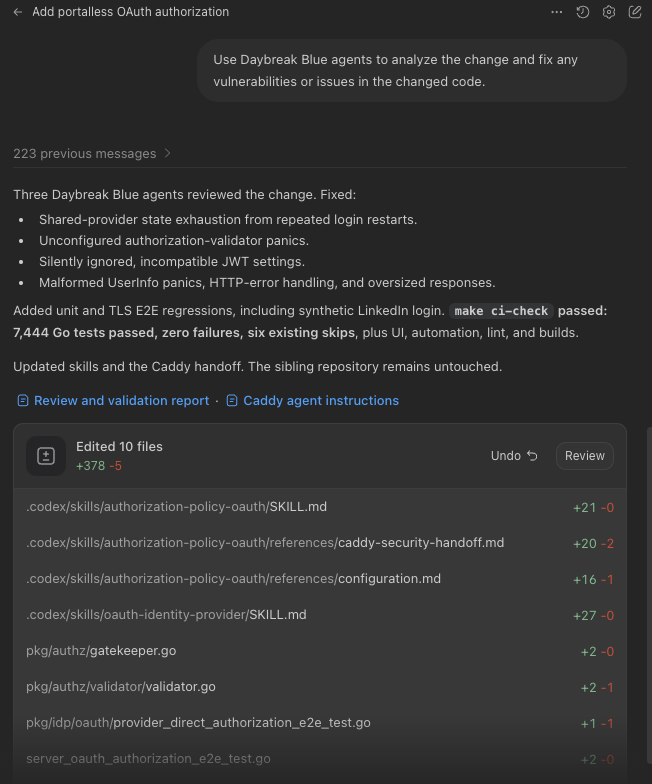
Use Daybreak Blue agents to analyze the change and fix any vulnerabilities or issues in the changed code.
That was my “Open Sesame.” The cave finally opened.
The request names Daybreak Blue agents, points them at the change, and asks them to fix what they find. It gives the review a concrete scope and a concrete outcome. In my session, it led to a report that three Daybreak Blue agents had reviewed the change.
I cannot tell from these screenshots which part of the wording made the difference, or whether the session context mattered. This is the phrase that worked for me with access already active. I have no evidence that it is a required password or that it grants additional permissions.
What the agents reported #
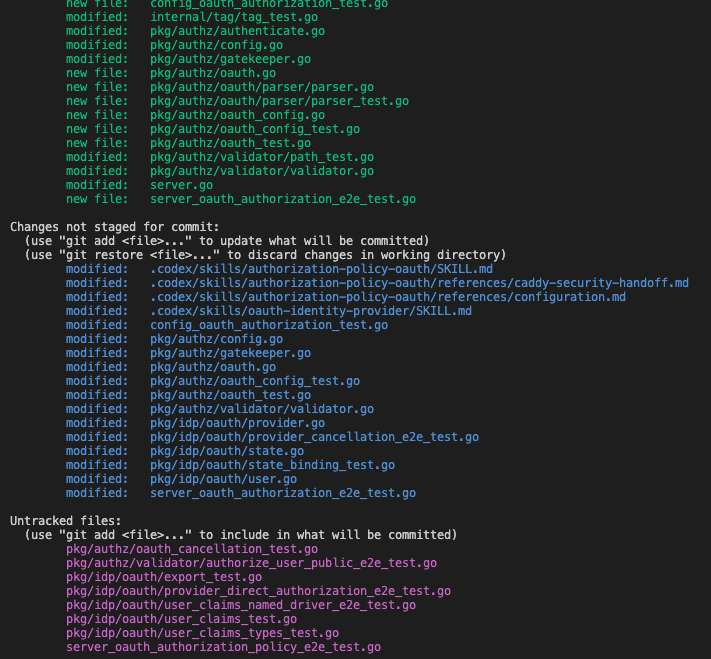
The work concerned OAuth authorization in go-authcrunch. The working tree captured during that work included implementation changes, regression tests, and updates to AI Agent Skills. That last category matters more than it might first appear.
The final response reported that three Daybreak Blue agents had reviewed the change and fixed:
- Shared-provider state exhaustion caused by repeated login restarts.
- Panics in an unconfigured authorization validator.
- Incompatible JWT settings that had been silently ignored.
- Problems handling malformed UserInfo, HTTP errors, and oversized responses.
It also reported added unit and TLS end-to-end regressions, including a synthetic LinkedIn login. The reported
make ci-check result was 7,444 Go tests passed, zero failures, and six existing skips,
alongside UI, automation, lint, and build checks. Those are the results recorded in the session's confirmation below.
AI skill engineering deserves credit #
There is great AI skill engineering work happening in both go-authcrunch and caddy-security. Their repo-local AI Agent Skills capture the details an agent needs to work responsibly in each codebase: who owns a behavior, which implementation to reuse, what must remain true, and how to validate a change.
In go-authcrunch, the OAuth authorization guidance separates the gatekeeper's responsibilities from the upstream provider's protocol and token verification. It records session lifecycle rules and the tests needed to check them. The review also updated the OAuth skills and the handoff for Caddy integration, preserving what the work had taught us.
In caddy-security, the skills connect Caddyfile configuration to the shared AuthCrunch implementation and describe how to test the components together. That is valuable engineering work. A passing library test still leaves the Caddy integration with its own behavior to verify.
The confirmation is specific about the boundary: this session updated the skills and Caddy handoff in go-authcrunch. The sibling caddy-security repository remained untouched. A useful handoff tells the next agent what to implement and validate without pretending that work has already happened.
This is why I care about AI skill engineering. When a review discovers an important rule, recording it in an AI Agent Skill gives future work a better starting point. The fix improves the code. The updated skill carries the lesson forward.
Keep the phrase, keep the context #
If you already have approved Daybreak Blue access and a change ready for defensive review, the copyable sentence above is the one I would keep nearby. Give the agents the relevant change and repository guidance, then inspect the diff and the validation evidence they produce.
If the request is still blocked, OpenAI acknowledges that legitimate work can trigger safeguards and provides false-positive reporting guidance. My successful session cannot diagnose somebody else's access or restriction.
I wish the path from “your access is active” to a working review had been easier to discover. But the moment it worked was satisfying: three agents, concrete reported fixes, regression tests, and better skills for the next task. I had the access. Now I had the words to put it to work.